
Decomposition (unplugged)
Unplugged Lesson

This lesson is unplugged, meaning you won’t need a laptop or computer – just the paper handouts!
Learning Outcomes
Learning intention: how to use decomposition in computational thinking.
- To break down a large task into smaller chunks.
- To understand the term decomposition.
- To develop digital citizenship.
- Using a grid, create a pixel image and list coordinates.
 Decomposition - whakamatariki
Squares in a grid
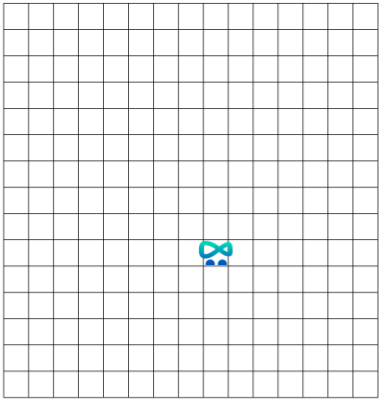
Here is a 15x15 grid:
 Kōrero Mai
How can you read coordinates in a grid?
- How can you name each square in the grid?
- How would you identify the square that ByteEd is standing in?
What we can do is label the grid in this manner:
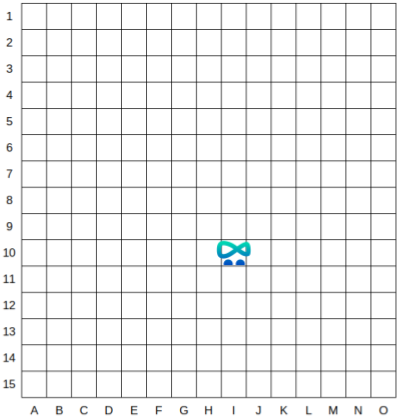
To name a square, you read:
- The letter first (on the horizontal axis), then
- The number second (on the vertical axis).
So, for the example above, ByteEd is on:
- letter: I
- number: 10
Therefore, ByteEd is on square “I10”.
 Activity Time!
Consider the following grid:
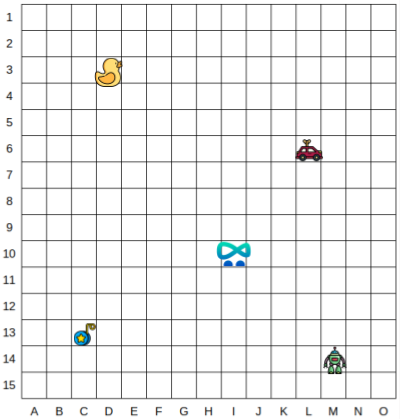
Which square has the Rubber duck?
Which square has the Car?
Which square has the Yoyo?
Which square has the Robot?
Research an island!
Research - rangahau
Your next task is to research some information online.
You are going to find out about New Zealand:
- How many islands are there in New Zealand?
- What shape are they?
Choose one island to explore further:
- What are its main cities or towns?
- Where are they located on the island?
Technological Practice: Design an Island
Decomposition - whakamatariki
Grab the 15 x 15 grid:
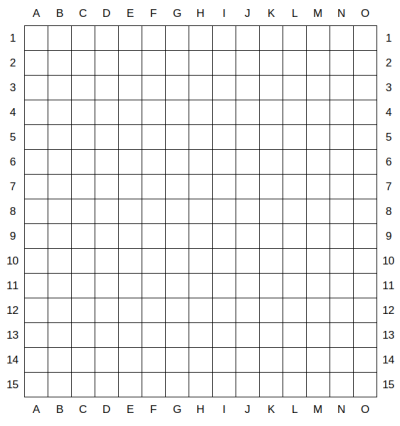
Now you need to colour in the squares to represent your your chosen island of Aotearoa:
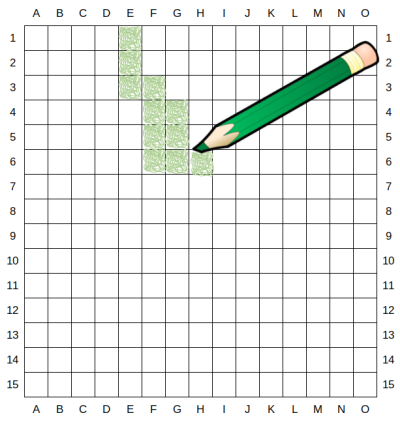
Need some help?
If you need some help representing your island, check the examples below:
What does the North Island look like?
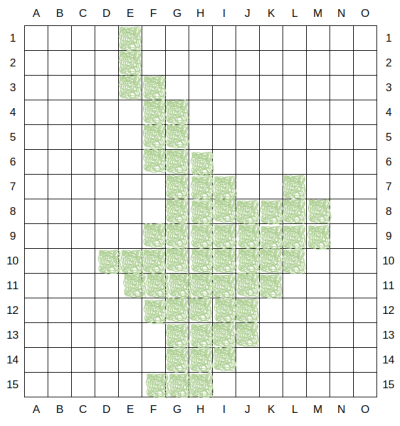
What does the South Island look like?
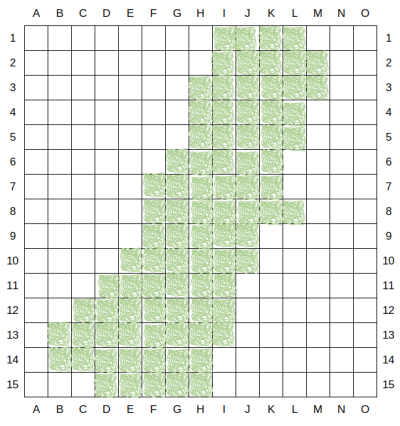
What does Stewart Island look like?
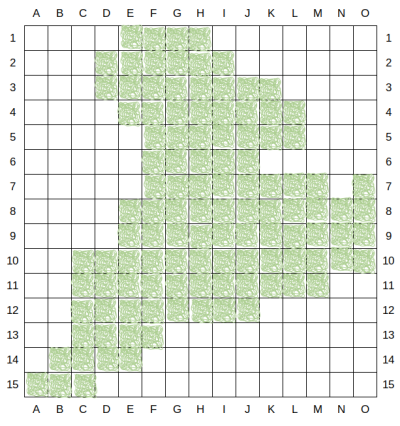
Label your towns and cities
When you have coloured in all of the squares for your chosen island, you can label cities, towns and/or destinations onto your map.
The decide on a starting point (origin) and an ending point (destination).
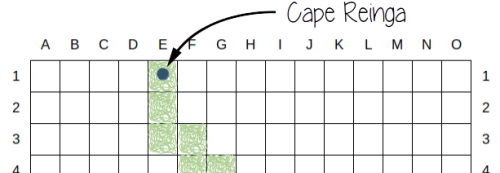
For example, on the North Island we might select Te Reinga Wairua (Cape Reinga) as the origin:
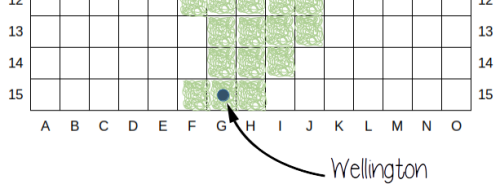
and Te Whanganui-a-Tara (Wellington) as the destination:
The next step is to list all the squares that you have coloured in green, using the grid coordinate (this will help in your next lesson).
For example, Cape Reinga in the example above is on E1, while Wellington is on G15.
It is a good idea to work logically from the top to the bottom of the island, listing all squares:
E1
E2
E3, F3
Kōrero Mai
Why do scientists and engineers use decomposition?
Scientists and engineers use decomposition for different reasons:
- Smaller tasks are more manageable.
- Smaller tasks are easier to understand.
- Problems can be found and solved more easily.
- Decomposition saves a lot of time.
- Helps to manage large projects.
- If broken down into smaller parts, the bigger task can be completed by a team - teamwork!
Computational Thinking
What is computational thinking?
Where does decomposition fit into computational thinking?
Watch the video to learn more…